It’s one of the most common questions in print:
“Is offset printing more expensive?”
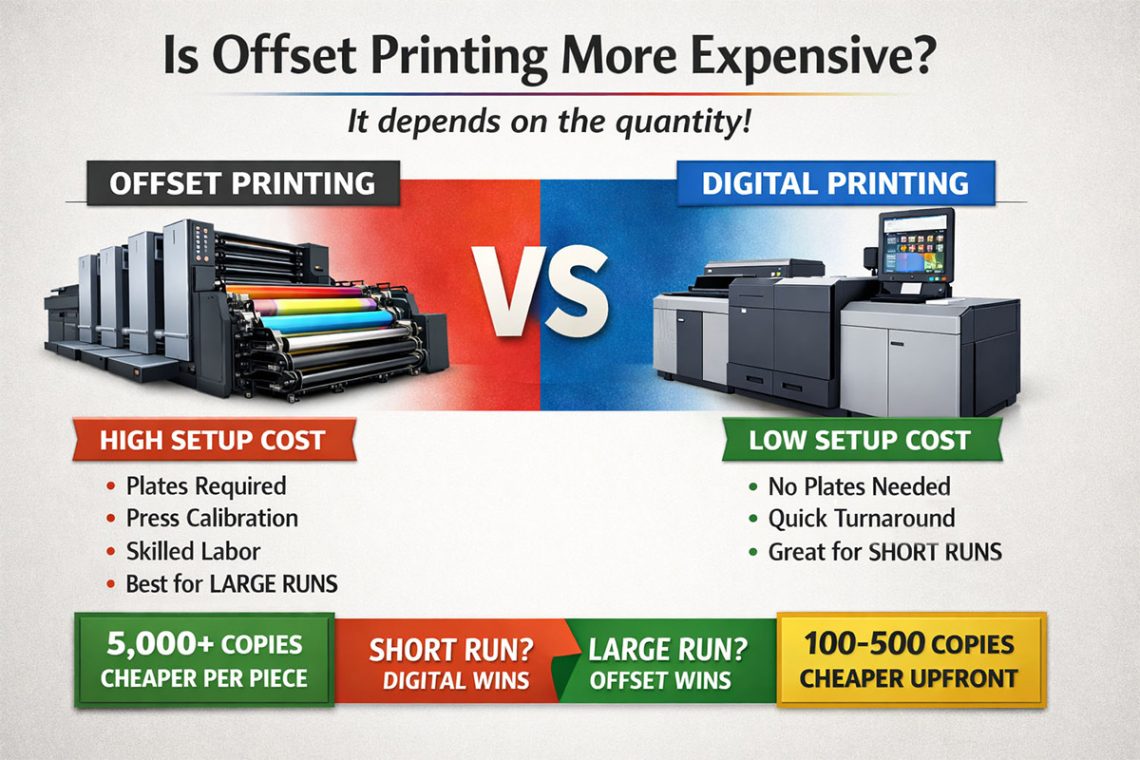
The honest answer: it depends on the quantity.
Offset printing is usually more expensive for short runs, but it can actually become more affordable for large quantities. Let’s break down why.
The Real Difference: Upfront Setup Costs
The biggest reason offset printing often costs more is the setup process.
Offset Printing Requires:
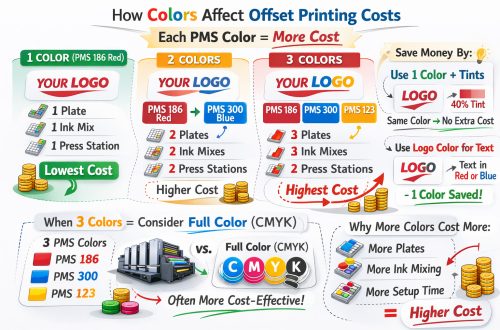
- Metal plates (one per ink color)
- Press calibration and color balancing
- Registration alignment
- Skilled operator time
- Paper waste during setup
All of this happens before the first sellable piece is printed. Those fixed costs are built into the job price.
Digital Printing Requires:
- No plates
- Minimal calibration
- Very little setup time
- Almost no startup waste
Because digital printing skips the plate and other required processes, it has significantly lower startup costs.
Fixed Cost vs. Per-Piece Cost
The pricing difference comes down to how each method spreads its costs.
Offset Printing
- High upfront (fixed) cost
- Low cost per piece after setup
Digital Printing
- Low upfront cost
- Higher cost per piece
This is why quantity matters so much.
When Offset Is More Expensive
Offset is typically more expensive when printing:
- 100 business cards
- 250 postcards
- 500 flyers
- Short-run marketing pieces
The setup cost doesn’t have enough pieces to spread across, so the per-unit price stays high.
For these jobs, digital printing is almost always the better financial choice.
When Offset Becomes Cost-Effective
Once you reach higher quantities, offset often becomes more economical.
Examples:
- 5,000+ brochures
- 10,000+ postcards
- Large booklet or catalog runs
- Ongoing branded materials
At that point, the initial setup cost gets distributed across thousands of pieces, lowering the per-unit cost.
In many long-run scenarios, offset becomes cheaper per piece than digital.
Why Offset Still Has a Place
If digital is cheaper for small jobs, why does offset still exist?
Because offset offers advantages such as:
- Precise Pantone color matching
- Specialty inks (metallic, fluorescent, etc.)
- Smoother gradients
- More consistent large solid ink coverage
- Greater flexibility with specialty papers
For brand-critical projects or large production runs, offset printing often delivers superior consistency and scalability.
The Simple Summary
Is offset printing more expensive?
- For short runs? Yes.
- For long runs? Not necessarily.
- For per-piece cost at high volume? Often cheaper.
Offset isn’t inherently more expensive. It simply has higher startup costs that make it less practical for small quantities.
Choosing the Right Method
When deciding between offset and digital, consider:
- Quantity
- Budget
- Timeline
- Color requirements
- Paper and finishing needs
Short run and fast turnaround? Digital is usually the answer.
Large run with tight color control? Offset may be the smarter investment.
If you’re unsure which direction makes sense, comparing quotes for both methods will quickly reveal where the cost crossover happens for your specific project. Our team can help you determine the sweet spot for your next printing project. Contact us whenever you’re ready!