NCR paper stands for No Carbon Required paper. It’s a special type of coated paper that allows multiple copies of handwritten or printed information without using carbon sheets. NCR paper is commonly used for invoices, receipts, bills of lading, and purchase orders.
In this article, we’ll explain how NCR paper works, what CB, CFB, and CF mean, and how middle copies transfer writing.
What Is NCR (No Carbon Required) Paper?
NCR paper uses micro-encapsulated dye and reactive clay coatings. When pressure is applied (by writing, typing, or impact printing), the capsules break and react with the coating on the next sheet, creating an exact copy.
No carbon sheets. No mess. Just clean and efficient copies.
Understanding NCR Paper Parts
1-Part NCR (No Copy)
1-part NCR paper is simply a single sheet with no copy transfer.
Used for:
- Receipts
- Order forms
- Notes where no duplicate is needed
There is no CB/CF coating interaction, so pressure does not create additional copies.
2-Part NCR (Duplicate)
A 2-part NCR form produces one copy.
Sheet structure:
- Top sheet: CB (Coated Back)
- Bottom sheet: CF (Coated Front)
How it works:
- The CB sheet has micro-encapsulated dye on the back
- Pressure breaks the capsules
- Dye reacts with the clay coating on the CF sheet below
- The writing appears on the second sheet
3-Part NCR (Triplicate)
A 3-part NCR form produces two copies.
Sheet structure:
- CB – Coated Back (top)
- CFB – Coated Front & Back (middle)
- CF – Coated Front (bottom)
4-Part NCR (Quadruplicate)
A 4-part NCR form creates three copies.
Paper sequence:
- CB – Coated Back (top)
- CFB – Coated Front & Back (middle)
- CFB – Coated Front & Back (middle)
- CF – Coated Front (bottom)
Each additional copy is made possible by adding another CFB sheet in the middle.
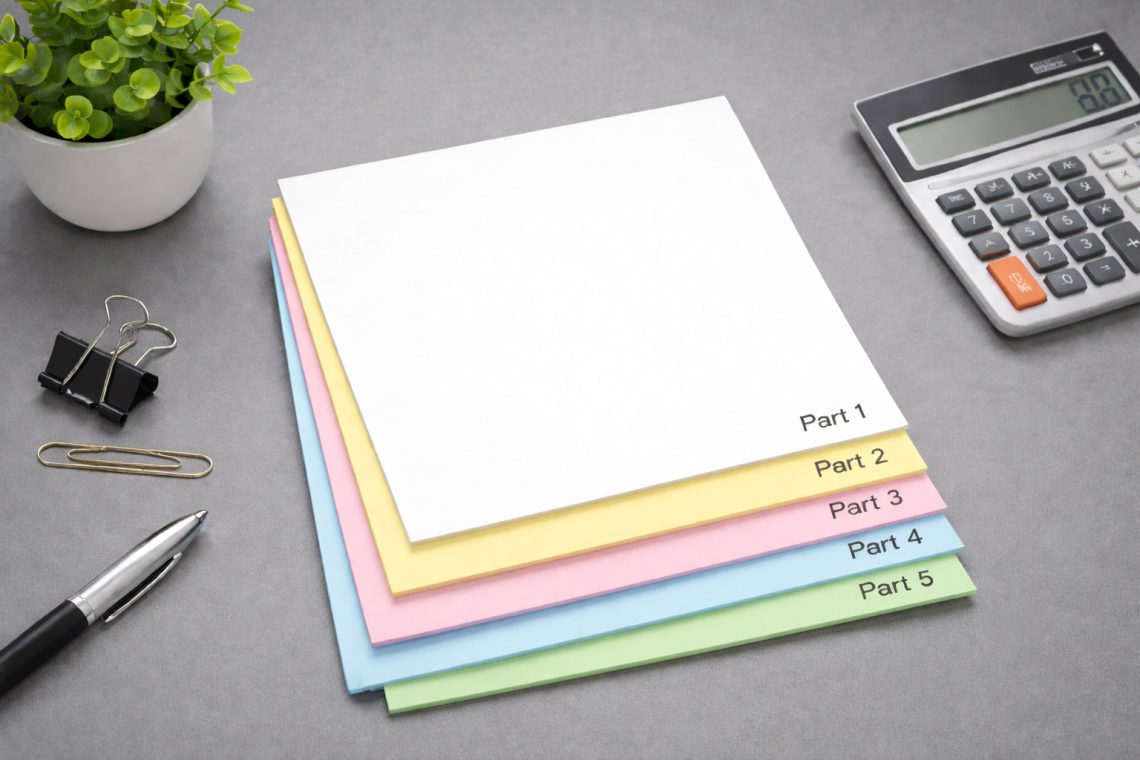
5-Part NCR (Quintuplicate)
A 5-part NCR form creates four copies.
Paper sequence:
- CB – Coated Back (top)
- CFB – Coated Front & Back (middle)
- CFB – Coated Front & Back (middle)
- CFB – Coated Front & Back (middle)
- CF – Coated Front (bottom)
This configuration is commonly used when multiple departments or stakeholders require a copy of the same information.
What Is CFB Paper and How Does It Work?
CFB (Coated Front and Back) paper is the middle sheet in multi-part NCR forms.
Why CFB Paper Is Special
CFB paper performs two roles at once:
- Front coating (CF): Receives the image from the sheet above
- Back coating (CB): Transfers the image to the sheet below
How Writing Transfers Through the Middle Copy
- You write on the top CB sheet
- Pressure breaks dye capsules on the CB back
- The image appears on the front of the CFB sheet
- The same pressure activates dye on the back of the CFB
- That dye transfers the image to the CF bottom sheet
This is how the middle copy shows writing and passes it along.
Common NCR Paper Types at a Glance
| NCR Type | Coating | Position |
|---|---|---|
| CB | Coated Back | Top sheet |
| CFB | Coated Front & Back | Middle sheet |
| CF | Coated Front | Bottom sheet |
Typical NCR Form Configurations
- 2-Part: CB → CF
- 3-Part: CB → CFB → CF
- 4-Part: CB → CFB → CFB → CF
Each additional copy adds another CFB sheet in the middle.
Common Uses of NCR Paper
- Invoices & billing forms
- Bills of lading
- Purchase orders
- Work orders
- Contracts & agreements
NCR paper is ideal anywhere instant copies are required.
Final Thoughts
NCR (No Carbon Required) paper eliminates the need for messy carbon sheets while still producing clean, reliable copies. Understanding CB, CFB, and CF paper helps ensure forms are ordered, printed, and used correctly.
If you need carbonless forms for your business, we offer a wide variety of options.